
Laser Treatments and Skin of Color: What’s Really True (and How to Find a Provider You Can Trust)
Updated: Oct 12
Inclusive Aesthetics • Laser Education Series
If you have melanin-rich skin and you’ve been told lasers aren’t for you, you’ve probably heard that more than once. Maybe a provider turned you away. Maybe you’ve seen stories online about burns or dark spots left behind after treatment. Those concerns are real, but they’re not the whole story.
“Laser hair removal, tattoo removal, skin resurfacing, anti-aging. All of those things can be done on skin of color. They just need to be done carefully, with the right provider and the right device.”
That’s Grace Grymes Chapman, DNP, founder of Inclusive Aesthetics, who has spent more than two decades treating patients across all skin tones, including performing laser treatments on skin of color and training other providers in laser safety. The concern, she says, isn’t about your skin. It’s about the provider and the equipment.
Laser treatments have come a long way for skin of color
For a long time, lasers had a real reputation for being risky on darker skin, and that reputation wasn’t completely wrong. Bad outcomes happened. But they happened because of the wrong equipment and providers who weren’t trained to treat melanin-rich skin. That’s not a skin problem. That’s a provider problem.
What "the right device" means in practice
Grace keeps returning to equipment, so it is worth naming what that means here.
Different lasers use different wavelengths, and wavelength determines how deep the energy goes and what absorbs it. Shorter wavelengths are absorbed more by melanin, which is why they carry more risk on darker skin. Longer wavelengths reach deeper with less interaction at the surface, which makes them safer for melanin-rich skin when treating hair or pigment.
The clinic’s first platform is the Lumenis M22, a medical-grade system that supports multiple wavelengths and handpieces. That range lets a treatment be matched to your skin tone, concern and history.
The clinic now works with two laser platforms rather than one. That is not about collecting machines. It is about having options, so a plan can be built around your skin instead of around whatever device happens to be in the room.
The newest addition is AuraLux, a customizable platform with three treatment levels.
3DMIRACL® is the lightest. It works on overall tone and texture and is designed as a minimal-downtime option.
Refresh targets mild to moderate sun damage, age spots, uneven complexion and fine lines.
Renew is the most advanced setting, used for wrinkles, scars and more significant rejuvenation. Collagen remodeling is the presumed mechanism of action.
Downtime is not the same across all three, which matters given what resurfacing asks of the skin. The lightest setting is built for very little recovery. The deeper settings ask more of your skin and more of your aftercare.
The manufacturer states AuraLux can be used across all skin types. That is where the conversation starts, not where it ends. Which level is appropriate, at what settings, spaced how far apart and with what preparation and aftercare, is a clinical judgment. It is the same point Grace makes about every laser. The device expands what is possible. The provider determines whether it is safe. Results vary.
What Grace asks before she ever starts a treatment
Grace’s consultation process is more thorough than many patients expect, and that’s by design.
“I don’t just look at the skin and say, this is this. We go through a series of questions.”
She asks about sun exposure and tanning habits. She asks about family background and ancestry. She asks about medications, skin history and any previous complications. She even asks about ethnic heritage, because someone who presents as fair-skinned may have Italian or other Mediterranean lineage that increases sensitivity to certain settings.
“That matters. You may present very fair, but that is something we need to know before we even get started.”
The consultation also covers medical history: skin conditions, medications, any history of keloids or skin cancer. If anything gives her pause, she’ll ask for a sign-off from a primary care provider or dermatologist before moving forward. And she’s honest about outcomes from the start.
Every laser consultation also includes a skin tone assessment using the Fitzpatrick scale, a review of any previous laser or light treatments, a look at your current skincare for anything that could affect treatment safety and a patch test when appropriate.
“I never over-promise. I’m going to tell you what I think is going to happen. And if it’s better than what I’ve said, then hey, we all win.”
The difference between laser hair removal and resurfacing
These two treatments often get lumped together, but they work differently and the rules are a little different depending on your skin tone.
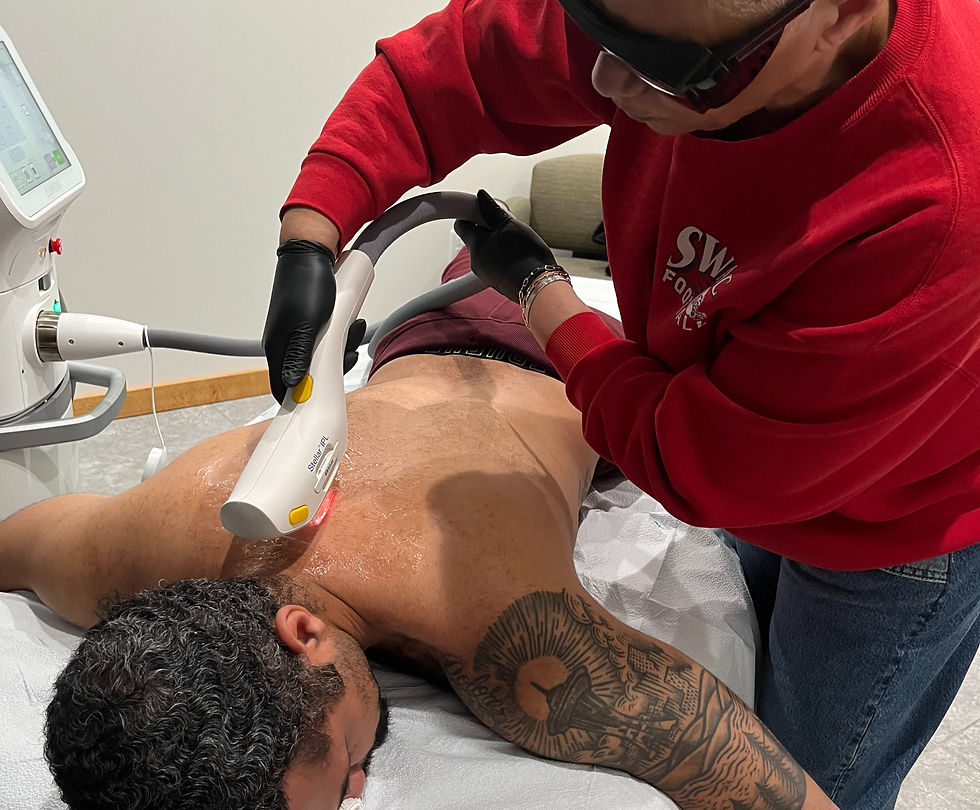
Laser hair removal targets the hair follicle. It takes multiple sessions, typically a package of treatments spaced out over time, because hair grows in cycles and no single session can catch every follicle at the right stage. Most clients need maintenance once or twice a year after their initial series. There’s generally no downtime, and in experienced hands on properly assessed skin, it’s safe across a wide range of skin tones.
Laser resurfacing addresses texture, fine lines, sun damage and discoloration. It works on a different layer of the skin and requires more careful planning for darker skin tones because of the increased risk of hyperpigmentation. Downtime varies. Lighter resurfacing typically means three to seven days of healing, while deeper treatments can take a few weeks. Avoiding sun exposure during and after healing isn’t optional.
Dark spots and melasma
Melasma in particular is notoriously tricky to treat on any skin tone, and on deeper complexions it requires an especially conservative approach. Aggressive laser treatments on active melasma can worsen it. But conservative, carefully planned treatments, with appropriate wavelengths, low energy settings and pigment-safe pre-treatment protocols, can reduce the appearance of melasma and dark spots over a series of sessions.
The realistic expectation is gradual improvement, not a single dramatic result. Treatment plans for pigmentation on deeper skin tones are built around protecting the skin’s long-term health while making incremental progress. That takes more time than some people want to hear, but it’s the approach that works without making things worse.
Sun damage, post-acne marks and uneven tone respond well to laser treatment when the protocol is right. These are among the most common concerns we treat at Inclusive Aesthetics.
Redness and visible vessels
Redness and visible capillaries are one of the more straightforward concerns to treat with laser across all skin tones, and it’s often a good starting point for clients who’ve been hesitant about laser in general.
What to expect during treatment
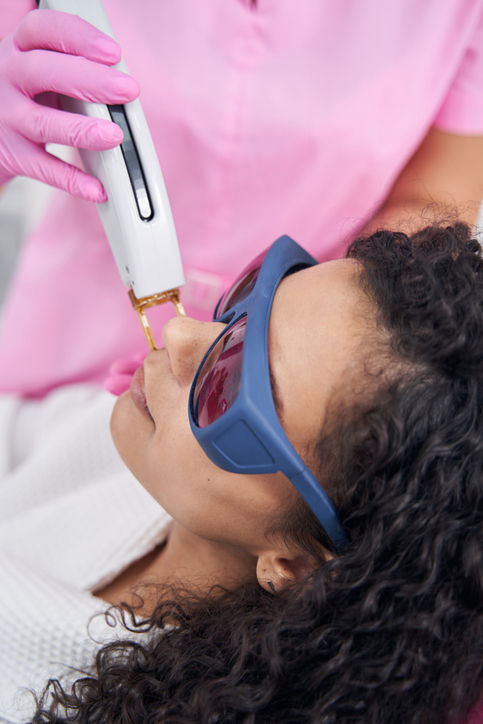
Sensations vary by treatment type. Laser hair removal typically feels like a warm rubber band snap, and Grace describes it as “snappy, spicy.” No numbing needed. Resurfacing and vascular treatments are more intense, so numbing cream is applied and left on for 10 to 15 minutes beforehand. A cooling device called a chiller blows cold air during treatment to help keep you comfortable. You’re always in control. If the sensation is too much, say so. Grace’s approach is direct: lower the settings, take a break, address it.
“You should know that you don’t have to suffer through this. It’s okay to say you’re in discomfort.”
Aftercare is part of the treatment
Safe laser treatment doesn’t end when you leave our clinic. Pigment-safe aftercare is part of the protocol, not an afterthought. For melanin-rich skin this typically includes specific instructions around sun avoidance and SPF use, products to calm and support barrier function after treatment, what to watch for in terms of normal vs. concerning responses and when to contact us if something doesn’t look right.
We send every client home with written aftercare instructions and product guidance. Your skin’s response in the days after treatment is part of the process and we want you to understand what you’re seeing.
What goes wrong and why
Grace has been called in to help patients recover from laser treatments that went badly elsewhere. Burns, blisters, hyper- and hypopigmentation. In her experience, the cause is almost always provider error.
“They weren’t paying attention to the settings. They weren’t paying attention to the patient’s discomfort. And they weren’t paying attention to the device or the color of the skin.”
When she steps in after a bad outcome, she says recovery takes at least two to three weeks of close contact, checking in constantly, adjusting care and making sure the patient is healing correctly. It’s manageable, but it’s avoidable.
What makes a provider worth trusting
Grace’s advice for evaluating any laser provider before you book:
Ask if they’re licensed.
Ask if they’ve been trained on the specific device they plan to use on you.
Ask how they would handle a complication if one came up.
Ask about their experience treating different skin tones and ethnicities.
“If they have any hesitation to any of those questions, you probably want to be looking for another provider.”
For her own practice, Grace holds membership in the American Society for Laser Medicine and Surgery and hosts training sessions at her clinic, on top of attending trainings outside of it. Her reasoning is simple.
“If you don’t know the depth of what you’re doing or where the laser is going to end up, you’re going to cause some injury. And that’s not what I want to do.”
She also knows this from personal experience.
“I’ve been burned. I’ve been poorly treated with laser, poorly treated with injections. I don’t want that for anybody else. So I make sure that I go to trainings all year long so that I come back and I’m the best that I can be for you.”
Start with a consultation
If you’re considering laser treatments and want to understand what’s right for your skin, a consultation is the best place to start. We’ll walk you through your options, explain what we’d recommend for your skin tone and answer your questions before you commit to anything.
Results vary based on skin tone, hair color, treatment history and individual response. A consultation is required before the first laser treatment.


Comments